
REVIEW EXCERPTS
‘Joanna Kavenna’s sparkling, audacious new novel...effervesces with as much energy as a geyser. […] Kavenna’s reframing of current anxieties around the harmful effects of AI on writers and artists raises important questions about the intersection between science and philosophy, the impact of digital technology on human thought. in her use of hybridity – the novel as a philosophical treatise, as a radical inquiry into the nature of being – Kavenna suggests that the form is no longer fit for purpose as a mere vehicle for narrative; now, more than ever, the novel must learn to reinvent itself. [A] wry, luminous novel, its brightness intensified by her precise, economical deployment of descriptive language, her unceasing intellectual curiosity’. Nina Allan, Times Literary Supplement.
‘A cerebral picaresque...Games are oases of meaning in an indifferent world…Kavenna captures this exquisitely. She is a writer of genuine elegance, intelligence and understated emotions. It is encouraging that there are those who still follow the pellucid postmodernism of Italo Calvino…’ Stuart Kelly, Spectator
‘Joanna Kavenna’s latest mind-bending novel…Philosophical concepts and dizzying speculations on the nature of reality have always featured in Kavenna’s novels, but here she ramps up the comedy, interleaving erudite playfulness with characters who are as believable as they are eccentric…This novel abounds with [fun].’ Suzi Feay, Financial Times Best Books of the Week
‘A book to blow the January cobwebs away…a serious, and seriously playful, book about play itself; the importance of beginning again and carrying on; of creativity, humanity, and hope. While some philosophical novels are portentous and indulgent, this one takes a palpable delight in language, is genuinely funny and warmly peopled (a chaos-causing elfin Hollywood actor very nearly steals the show). It’s subtly but unmistakably timely too.’ Stephanie Cross, Daily Mail
‘Joanna Kavenna’s new novel, SEVEN, is an absolute delight, proving that the cerebral and the satirical, the poignant and the preposterous can sit easily’ Scotsman
‘Joanna Kavenna’s two decades as a writer have seen her beat a gorgeously unconventional path through a plethora of subjects and genres, from polar exploration to motherhood to economic inequality, and from travelogue to academic satire to technological dystopia….Her seventh published book, SEVEN, is a curiously uncategorisable, protean thing: a slim, absurdist novel, but chunky with ideas….Kavenna’s philosophical rigour is leavened throughout by a generous sense of humour. Her characters are pleasingly outrageous.’ AK Blakemore, Guardian
‘ Seven by Joanna Kavenna is the most brilliant novel I’ve read in AGES, part academic satire, part philosophy of AI and gaming, all hubris-puncturing wisdom worn with such levity I was cackling from start to finish. Astonishing writing.’ Adam Rutherford BBC Radio 4 Start the Week
‘Proof that a good book can be philosophical…A thoroughly pleasurable, as well as philosophically demanding, read.’ Telegraph
‘There’s something special about a writer who seems to have limitless reserves of imagination...[Kavenna’s] novels have ranged in scope from the distant past to the future (sometimes in within one book), with subjects including alternative realities, quantum physics and tech barons. It’s big, brainy stuff but always with a playful edge. Kavenna’s new novel Seven shows no sign of changing that approach....The book is a headscratcher and a pleasure by turns…Ceaselessly inventive.’ Times
'Joanna Kavenna’s seventh novel is much easier to enjoy than to describe. I could say that it’s a trans-European philosophical adventure about an ancient board game with no fixed rules, but it’s also about AI, academia, the shape of the universe, a Society of Lost Things and the Nazi occupation of Crete. And it’s very funny. Kavenna combines the intellectual playfulness of Borges or Eco with the kind of beguilingly chatty narrative voice you find in Ishiguro to achieve a rare balance of profundity and levity — a deliciously unpredictable comedy of ideas. Seven reads like a dream, in both senses of the word.’ Dorian Lynskey, The Nerve
‘A surreal, time-warping quest…an uplifting odyssey’ - Financial Times What to Read in 2026
‘SEVEN, Joanna Kavenna’s latest, is spellbinding; a truly stand-alone talent.’ - Niamh Mac CabeIrish Independent
‘In an era that often feels profoundly joyless, when crises continue to stack up like a dismal game of Jenga, Joanna Kavenna’s latest novel provides a buoyant and often dizzying exploration of the nature and values of play. [The opening scene] establishes the novel’s tone - amusing without being glib - and demonstrates Kavenna’s ability to shift from philosophical musing to comic drama and raw grief. Kavenna’s novel, skilfully handled, is not a breathless warning about humanity’s obsolescence in the face of machines, but a subtle exploration of what else is lost when we abandon the spirit of play.’ N S David, The Literary Review
‘Where to begin with this pleasingly puzzling tale? We meet our unnamed narrator shortly after they get a job as an assistant to a philosopher who is writing a book about ‘thinking outside the box about thinking about the box’ – which is a pretty good a piece of advice on how to approach this rather brilliant, brain-twisting novel about – among many other things – a missing box of the ancient (fictional) game of Seven of the title. They’re sent on various quests across Europe that are pretty much all in the name of the game, with Kavenna throwing in both big and small ideas aplenty along the way on friendship, loyalty, the horrors of war, the slippery nature of truth, time and the whole dang universe. There is even, of all things, a cameo from Aha singer Morten Harket. Funny, absurd, astute: don’t try to overthink it – just settle in and open your mind to a reading experience that sits well and truly outside the box.’
Catherine Jarvie,
‘The Smart, Scandalous and Seriously Hyped Books to Read This February’ Marie Claire
‘Kavenna has conjured some sort of alchemic mix of Slaughterhouse-Five with a David Lodge academic satire, and Piranesi. It’s a story about a made-up board game, its obsessive players and artificial intelligence, which is more insightful than the slew of non-fiction books on AI by so-called experts. I cackled my way through this bonkers masterpiece.’ Best Books, The Week
‘Kavenna’s seventh novel (following Zed) is visionary yet down-to-earth. Three story lines emerge. An Icelandic philosopher hires the narrator to work on the problems of TOTBATOTB, a nickname for a concept called “Thinking Outside the Box (About Thinking Outside the Box)”. Politeness and anger highlight their intense work to meet deadlines. Next, the narrator meets a Greek dentist whose passion is his Catalogue of Lost Things, aimed at getting to the bottom of what can be lost and found. A New Zealand soldier’s bloody story emerges and leads to an entrancing board game, Seven, whose long history is tracked from ancient Greece to AI game players. The game’s rules of play possibly connect to the kernels of wisdom within TOTBATOTB. Enmeshed in these spiraling tales, Kavenna’s narrator travels spiritedly through the realms of academe, war, and why humans love to play. Soldiers are mangled, treasured objects are lost, couples wrangle, and loved ones die in this picaresque tale. VERDICT Recognized in Britain as a major talent, Kavenna has already earned her spot on major lists of books to read in 2026. Beautifully crafted, challengingly brainy, and playfully edgy, it will inspire readers to yearn for her next launch.’ Library Journal (starred review)
‘Fizzing with wit, tricks and big ideas, Joanna Kavenna’s latest novel carries a hefty cargo. There are quests (for lost objects and spiritual enlightenment); boxes (both literal and metaphorical); and games (strategic, philosophical and metafictional). It’s also freighted with reflections on epistemology (knowledge and truth) and ontology (reality and being). The structure is complex and the concepts challenging, but Kavenna’s intellectual ambition is complemented by her playfulness: the result is a ludic novel in the tradition of Helen Oyeyemi, Peter Ackroyd and Italo Calvino…A game for two players, Seven is played on a circular board with a single pathway from its periphery to its centre, in the form of a seven-ringed labyrinth. It is played with six-sided dice, seven pebbles per player and pieces representing angels and dragons. The rules are simple but allow for intricate variations of strategy. The most important aspect of the game is that it springs entirely from the imagination of Joanna Kavenna. It’s a tribute to the subtle power of the author’s writing that her reports of international championship matches created a moment or two of doubt: it took an online search to prove I hadn’t failed to hear of this fascinating form of cerebral contest. When the current, allegedly unbeatable, World Champion is persuaded to play an AI, scandal ensues and people begin to lose their passion for the game. Another erasure. It’s an absurd and entertaining proposition, but a powerful and provocative way of posing profound questions about the function of play, the intervention of algorithms in human activity and the provisional nature of the way we label and construct reality.
Kavenna is an accomplished satirist. Her exploration of the thin line between academic rigour and preciousness is even-handed but amusing, while her deft portrayals of the destructive and ignorant super-rich are reminiscent of the “careless people” in Fitzgerald’s The Great Gatsby. That wasn’t the only literary memory prompted by Seven: there are subtle echoes of Michael Frayn’s philosophical comedies, Borges’ fascination with labyrinths and the psychological games of John Fowes’ The Magus. …Kavenna’s writing is elegant, thought-provoking and witty. Who knew you would have this much fun with the slippery and elusive notions of knowledge and existence?’ Andy Hedgecock, The Morning Star
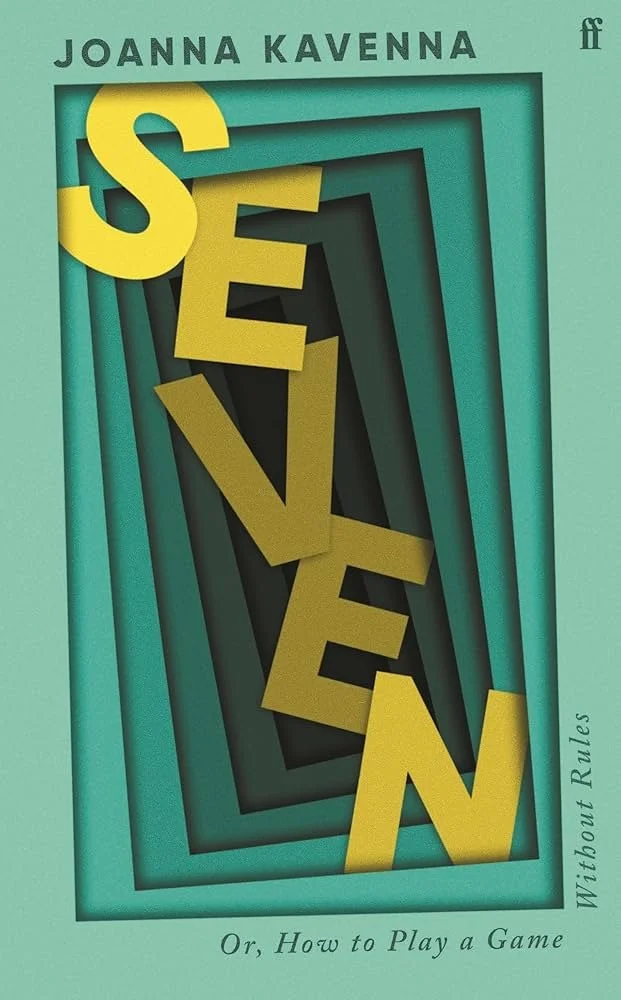
Seven
Guardian Book of the Day and This Week in Rave Reviews
Financial Times What to Read in 2026 and Best Books of the Week
LitHub Most Anticipated Books 2026
New Scientist Best Science Fiction Books of 2026
Tatler Buzziest Books 2026
Scotsman Books for 2026
Herald Top 10 novels for January
Irish Independent Books of 2026
Marie Claire Books to read this February
Bookseller Books in the Media
The Nerve Hotlist
Best Books, The Week